
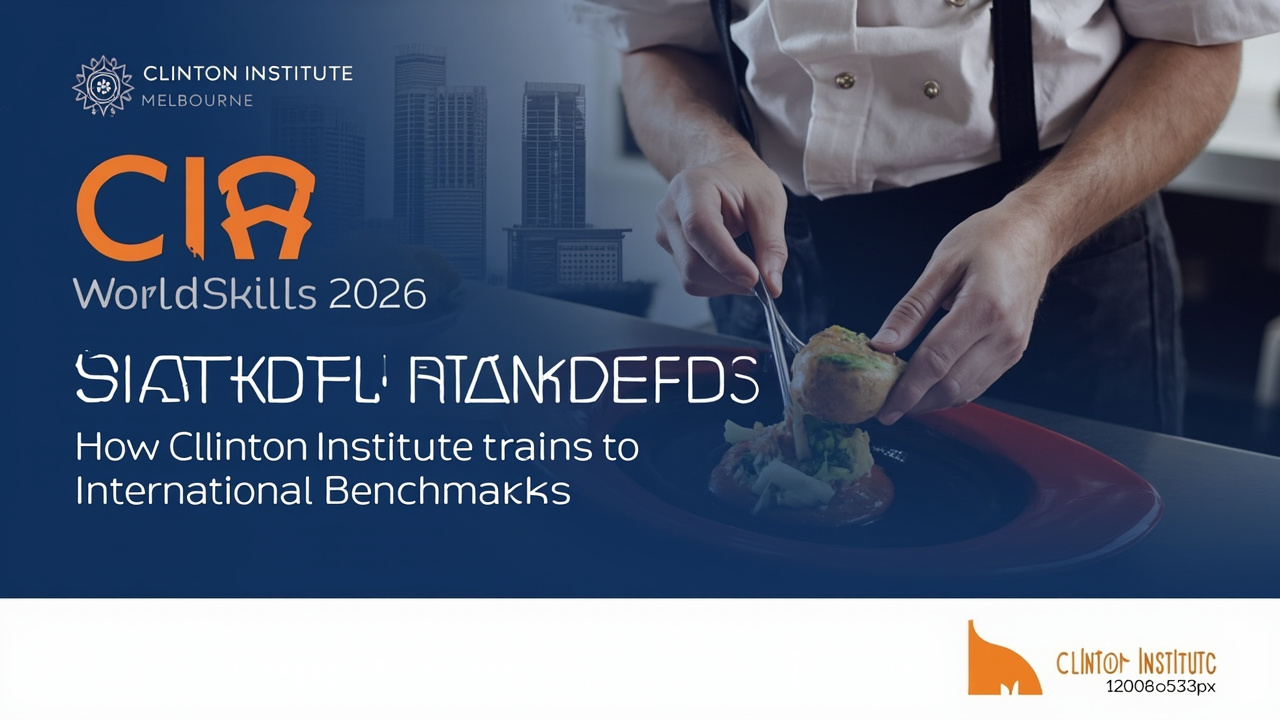
WorldSkills 2026 Cookery Standards — How Clinton Institute Trains to International Benchmarks
Published: 7 August 2026 | Clinton Institute | RTO ID: 41597 | CRICOS: 03540C
While the world's best cookery students are sharpening their knives for WorldSkills Shanghai 2026 (22–27 September), Melbourne students can train to the same international benchmarks at Clinton Institute (RTO ID: 41597, CRICOS: 03540C) — and start their chef career in months, not years.
What Is WorldSkills and Why Does It Set the Standard
WorldSkills is the global gold standard for vocational skills excellence — a competition held every two years that brings together young tradespeople and chefs from 63 countries and regions, with more than 1,500 competitors judged against the same international benchmarks at each event. The cookery and hospitality competition is one of the most closely watched events: knife skills, pastry, hot and cold food preparation, restaurant-style service, and menu planning — all tested under strict WorldSkills competition conditions at SIT30821 and SIT40521 level.
WorldSkills Shanghai 2026 (22–27 September, Shanghai) is the 48th WorldSkills Competition. Australia has been a WorldSkills participant since 1980, with regional competitions running in every Australian state and territory from February to October 2026 — giving Australian SIT30821 Certificate III and SIT40521 Certificate IV students a direct pathway from training to the international stage.
For students considering a cookery career in Melbourne, the WorldSkills benchmarks are more than a competition framework. They are a description of what restaurant-quality cookery actually requires: precision, speed, hygiene, and the ability to perform under pressure. That is exactly what Clinton Institute's (RTO 41597) Community Training Kitchen and mandatory work placement at Crown Melbourne, Accor, and partner venues are designed to develop.
"WorldSkills benchmarks exist because the hospitality industry demands a specific standard of competence — not just knowing how to follow a recipe, but understanding why a dish works, how to adapt under time pressure, and how to present food that meets international expectations. When I train students at Clinton Institute, those are the standards we work to, regardless of whether they compete in WorldSkills or not. The students who train to that level are the ones who walk into commercial kitchens and perform."
— Sanjeev Kumar, Commercial Cookery Trainer and Assessor, Clinton Institute
What WorldSkills Cookery Actually Tests
The WorldSkills cookery competition is structured around five core skill areas — each one directly relevant to what a Melbourne restaurant kitchen requires every service:
- Knife skills and vegetable butchery — precise cuts, portion control, and presentation. Speed and consistency are judged equally.
- Hot kitchen: proteins and sauces — cooking meat, fish, and poultry to correct temperatures; building flavour through classical and contemporary sauce techniques.
- Pastry and desserts — laminated doughs, classical pastries,巧克力 work, and restaurant dessert service. Precision and timing are paramount.
- Restaurant-style service and plating — the final plate is judged on visual presentation, portion size, and temperature as much as flavour.
- Menu planning and cost awareness — competitors must produce a three-course menu within a budget, demonstrating commercial awareness alongside technical skill.
These same WorldSkills competencies are embedded in SIT30821 Certificate III in Commercial Cookery (CRICOS: 110552J) and SIT40521 Certificate IV in Kitchen Management (CRICOS: 110553H) at Clinton Institute (RTO 41597, CRICOS 03540C). The difference is that Clinton's training happens in a real commercial-grade kitchen environment — not a classroom — before students enter their mandatory work placement.
How to Become a Chef After Year 12 in Melbourne
The pathway from year 12 to qualified chef is shorter than most people expect. The standard route in Melbourne:
| Qualification | Duration | Typical Role After |
|---|---|---|
| SIT30821 Certificate III in Commercial Cookery | 6–12 months | Kitchen attendant, commi chef |
| SIT40521 Certificate IV in Kitchen Management | 6–12 months (while working) | Line cook, demi chef, kitchen supervisor |
| SIT50422 Diploma of Hospitality Management (Cookery) | 6–12 months (while working) | Sous chef, kitchen manager |
Clinton Institute (RTO ID: 41597, CRICOS: 03540C) offers SIT30821, SIT40521, SIT50422, and SIT60322 — from entry-level Certificate III through to Advanced Diploma — with monthly intakes and flexible study options for Melbourne students. Students can start with Certificate III immediately after year 12 and be working in a commercial kitchen within months.
The Community Training Kitchen: Where Standards Are Set
Clinton Institute's Community Training Kitchen in Melbourne's CBD is the facility that bridges the gap between theory and commercial kitchen reality. Fitted with commercial-grade equipment — salamanders, induction cooktops, full utensil sets, and refrigeration — students log 200+ hours of hands-on practice here before entering mandatory placement. The Community Training Kitchen simulates the exact environment students will work in every service after graduation.
Unlike RTOs with online-only cookery theory, Clinton Institute students spend most of their course time in the Community Training Kitchen — a commercial-grade facility in Melbourne's CBD. They prep, cook, plate, and clean — the same cycle they will repeat every service in a real restaurant.
WorldSkills regional competitions across Australia are running now through October 2026. Students who train at Clinton Institute's Community Training Kitchen are training to exactly the standards those competitions judge against.
Mandatory Work Placement: The Real Kitchen Test
Clinton Institute (RTO ID: 41597, CRICOS: 03540C) arranges mandatory work placement for all cookery students with a network of 50+ Melbourne hospitality employer partners including Crown Melbourne and Accor properties. Placement is structured and supervised — students are not sent to find their own kitchen shifts. An on-site Clinton assessor visits each student during SIT30821 placement to evaluate performance against the same WorldSkills-aligned competencies.
This structured placement model means Clinton graduates arrive at job interviews with real commercial kitchen hours already completed — not just theory. Employers in Melbourne's hospitality sector — including Crown Melbourne, Accor properties, and independent venues — consistently tell Clinton Institute's trainers that this is the differentiating factor they look for when hiring SIT30821 graduates.
Melbourne Chef Salaries in 2026
The Melbourne hospitality market faces a persistent chef skills shortage, with kitchen vacancies taking an average of 6–8 weeks to fill — driving above-award pay for qualified candidates. Current market rates:
- Kitchen attendant / entry-level: $27–$32 per hour
- Qualified cook (Certificate III): $32–$40 per hour
- Chef de partie / section cook: $40–$50 per hour
- Sous chef: $50–$60 per hour
- Head chef / executive chef: $60+ per hour, often with service charges and bonuses
Weekend and public holiday loadings under the Restaurant Industry Award add meaningful income on top of base rates.
Chef for a Day: Experience Clinton's Kitchen Before You Enrol
Clinton Institute is running a Chef for a Day workshop at the Community Training Kitchen on Saturday 22 August 2026. School leavers, career changers, and anyone curious about a cookery career can spend a Saturday working alongside Clinton's trainers in the same kitchen used for Certificate III and Certificate IV training.
No experience required. Spaces are limited. Register interest via Clinton Institute's admissions team.
Frequently Asked Questions
What is WorldSkills and why does it matter for cookery training?
WorldSkills is the global gold standard for vocational skills excellence, held every two years. The cookery competition tests knife skills, pastry, hot and cold food preparation, restaurant-style service, and menu planning under competition conditions. Training to WorldSkills benchmarks means students develop restaurant-level precision, speed, and presentation — not just theory.
When is WorldSkills Shanghai 2026 and can I attend?
WorldSkills Shanghai 2026 runs 22–27 September 2026 at the National Exhibition and Convention Center in Shanghai, China. The event is open to spectators. Australian cookery students can attend through WorldSkills Australia regional competitions running across Australia from February to October 2026.
What cookery qualifications does Clinton Institute offer?
Clinton Institute (RTO ID: 41597, CRICOS: 03540C) offers SIT30821 Certificate III in Commercial Cookery, SIT40521 Certificate IV in Kitchen Management, SIT50422 Diploma of Hospitality Management (Cookery stream), and SIT60322 Advanced Diploma of Hospitality Management (Cookery stream). All include mandatory work placement.
Can I study cookery after year 12 and become a chef?
Yes. SIT30821 Certificate III in Commercial Cookery is a direct post-year-12 pathway into the hospitality industry. Most Melbourne students complete their certificate and start as kitchen attendants or commi chefs within months of graduating. Many then upskill to Certificate IV and Diploma while working.
How long does it take to become a qualified chef in Melbourne?
A typical timeline: Certificate III (6–12 months) → kitchen experience → Certificate IV (6–12 months) → line cook or demi chef → Diploma (6–12 months) → sous chef or kitchen manager. Clinton Institute offers all four qualifications with flexible study options.
How much do chefs earn in Melbourne in 2026?
Entry-level kitchen attendants earn $27–$32 per hour. Qualified cooks (Certificate III) earn $32–$40 per hour. Chefs de partie earn $40–$50 per hour. Sous chefs earn $50–$60 per hour. Melbourne's hospitality market pays above award for skilled candidates, and weekend loadings add significantly to take-home pay.
Ready to train to international cookery standards in Melbourne?
Clinton Institute (RTO ID: 41597, CRICOS: 03540C) offers SIT30821 Certificate III in Commercial Cookery, SIT40521 Certificate IV in Kitchen Management, and SIT50422 Diploma of Hospitality Management (Cookery stream) for students in Melbourne. Apply now or contact our admissions team.
SIT30821 Certificate III in Commercial Cookery | SIT40521 Certificate IV in Kitchen Management | SIT50422 Diploma of Hospitality Management
Clinton Institute is a registered training organisation (RTO ID: 41597, CRICOS: 03540C). Learn more about us.